January 8, 2026
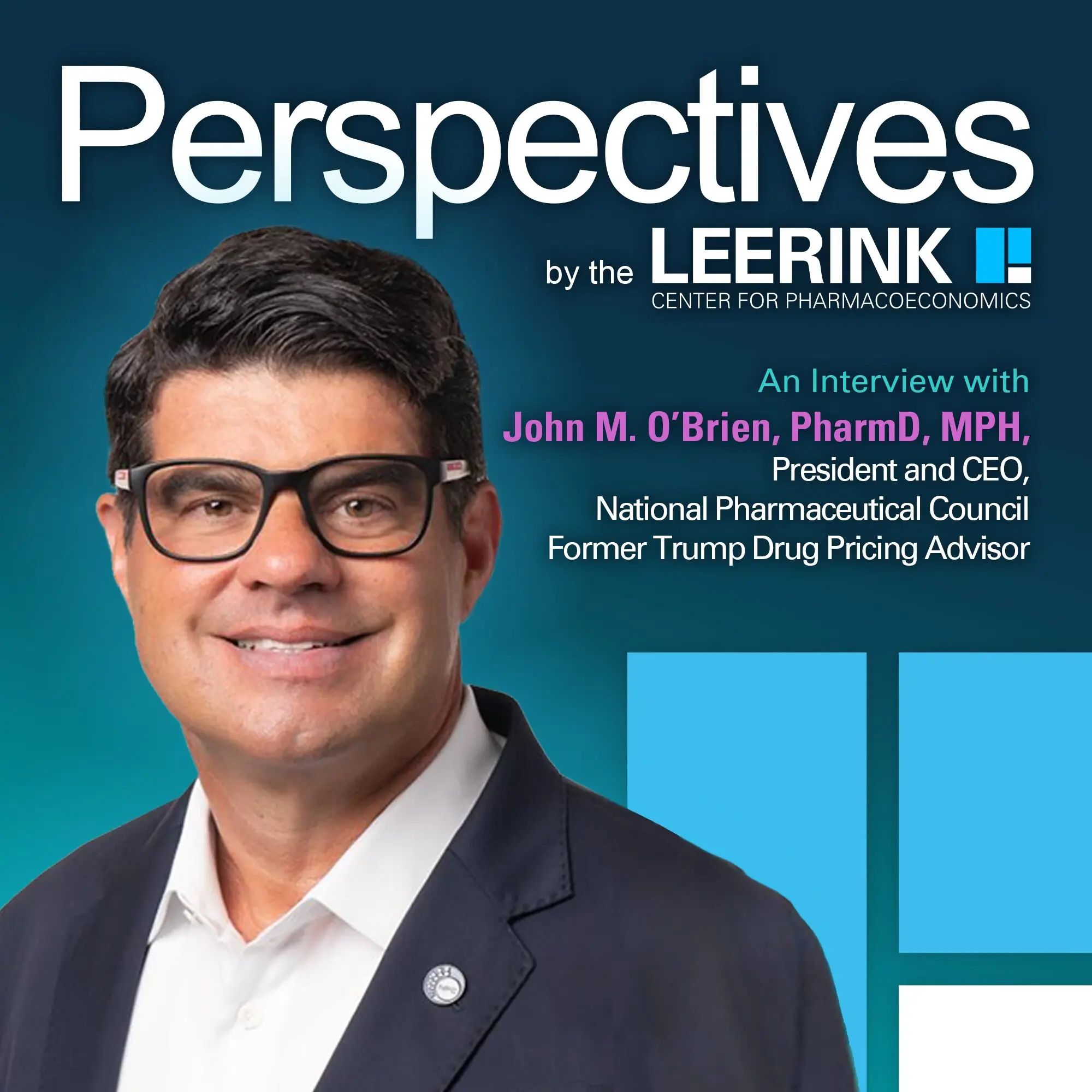
Welcome to Perspectives, a signature podcast series from The Leerink Center for Pharmacoeconomics. Hosted by Dr. Mel Whittington, a health economist and Head of the Center for Pharmacoeconomics, we will be hearing from individuals across the industry to better understand and appreciate the societal impact of healthcare innovations.
Mel Whittington: Hi, everyone. You know we’re at a time when the US seems to be thinking a lot about drug pricing, and we’ve seen everything from Medicare drug price negotiation to most favored nation pricing to value assessment frameworks. And so, we’re going to dig into some of this today, and we’re going to ask some big questions like how do we reward innovation while not busting budgets and what does a sustainable, yet innovation friendly drug pricing system actually look like and can we get there? And so, to tackle these questions, I’m joined by someone who knows much more than I do, who sits right at the intersection of policy, innovation and evidence. And it’s none other than Dr. John O’Brien, who’s the president and CEO of the National Pharmaceutical Council, which is an organization that’s spent decades conducting research and providing evidence to inform these conversations and inform the value of patient access to innovative pharmaceuticals. And before NPC, John held senior roles across government and industry, including at HHS and CMS. And he’s really worked on some of the most consequential drug pricing policies of the last decade. And he’s one of those rare voices who can speak across multiple sides of the table from policymakers to drug companies, but he’s also just one of the most interesting people I have ever met. So, I have no doubt this is going to be a lot of fun. John, thanks for coming on the podcast, about time.
John O’Brien, PharmD, MPH: Well, thanks for having me, Mel. I’m honored to be the second guest from the National Pharmaceutical Council.
Mel Whittington: Okay, we had a lot to talk about. My first question is something I’ve always wanted to ask you, and that is you worked for the first Trump administration. What was that like?
John O’Brien, PharmD, MPH: It was awesome. As you said, I was a career official at CMS a few years early in an awesome, albeit process-oriented job. And then I left government, went to work for a health plan for a bit. And it was a real honor for the White House Personnel Office to bring me back as someone who knew policy and process in a role where I got to use all of it every day. And when I look back, you know, we did important work laying the groundwork for more people to understand the perverse incentives in the channel and the arbitrage that has existed then. And I think it’s at a tipping point today. You know, not many knew about the drug channels inner workings until President Trump’s drug pricing blueprint. And that’s why I take the president and his team very seriously, you know, more than a few close friends went back in and there are people there who really understand how the value chain works and how drug contracting affects bigger picture health care policy. So, you know everyone’s talking about the May most favored nations executive order, but I wouldn’t overlook the April executive order either. And that may be the first time any of us ever saw the words “value chain” in a government document.
Mel Whittington: Fascinating. Well, you know, I’m glad your perspective was there and appreciate all of the insight that you bring. Now you are the CEO of National Pharmaceutical Council. So how do you define your role or NPC’s role in really shaping the US drug pricing landscape and taking all of your breadth of expertise in a variety of areas and then you’re really working to make the system better?
John O’Brien, PharmD, MPH: Oh my gosh, Mel, this is my dream job. And you said it right, like, NPC has been doing this for decades. We’ve actually been around since 1953. So, I’ve been a long-time consumer of that research and pharmacy student research for me is still giddy that they asked me to join as CEO five years ago. Today, we serve patients in society with policy relevant research on the value of patient access to innovative medicines and the importance of continued scientific advancement. So, we don’t lobby, we’re not an advocacy organization, and we believe that good policy is based on good evidence. And I get to be a part of it every day by working with this amazing team of PharmDs, PhDs, some with decades of experience, others who are rising stars. And then we work together to develop rigorous research, both internally with Dr. Campbell and the great team that he’s built, as well as external leaders and co-authors like you. Sometimes we publish it in peer-reviewed journals, and we always communicate it with impact. And when I’m not doing that, I get to work with a board of directors and member company work groups made up of leaders from across the pharmaceutical industry. So, it really is the best of both worlds to me. And you can either read about our work in a peer-reviewed journal or our weekly newsletter on LinkedIn. And if you’re not currently seeing it, I hope your listeners follow and subscribe.
Mel Whittington: Yeah, I hope they do too. And you guys have been so productive. I am subscribed and I’m on the distribution list. And I feel like it’s multiple times a week I’m getting an email about this new peer-reviewed publication. And I appreciate all the timely and insightful evidence.
John O’Brien, PharmD, MPH: Well, it’s the Mutual Admiration Society, Mel, because we write about your work often in our newsletter.
Mel Whittington: I love it. You talked about the member companies and most of NPC’s member companies are large pharmaceutical companies. Large pharmaceutical companies don’t have the best reputation, but I know you and I have a much different perspective and view of the industry. What do you see as the most misunderstood aspect of the industry among policymakers, which you’ve seen that lens, and then even just the general public?
John O’Brien, PharmD, MPH: You know, so first we are lucky that our board of directors does include representatives of smaller companies all the way up to the largest companies. So, it’s great to get, you know, that perspective. And I think something that they all face is something that’s not very easily understood. Did I ever tell you about the time I took my mom to get her flu shot?
Mel Whittington: I don’t think so.
John O’Brien, PharmD, MPH: So, before she gets up in the chair to get her shot, she hands the pharmacist a prescription and the technician fills it while she gets her flu shot and she comes back and the pharmacist hands her the bag and my mom says, “you gave me the brand, I wanted the generic.” And the pharmacist says, “well, your health plan doesn’t pay for the generic, it pays for the brand.” And my mom says, “well, that’s probably because of the rebates.” And the pharmacist looks over at me and I’m like, “hey, I don’t know where she gets this stuff.” But most members of the general public aren’t my mom. And when people at her Monday night bingo game talk about drug prices being too high, they’re talking about the price that they’re being asked to pay at the pharmacy counter. They’re not being asked about WAC or know the difference between list and net. And as you know all too well, and your research has even talked about, prescription medicines are the only healthcare good or service where what the patient is asked to pay is based on the billed amount in insurance company parlance or list price and drug pricing parlance, as opposed to the allowed amount or the net price. And that’s what I think is the industry’s biggest problem. We have a healthcare system that views medicines as an arbitrage opportunity, a way to extract margin from drug spending, as opposed to seeing medicines the way a patient does, something that helps my mom get well, stay healthy, and avoid more costly or cumbersome settings of care. So, for policymakers and others who are trying to understand this work, how this all works, let me explain a couple important misperceptions. You know, first, it’s important for people to understand that while this may seem easy on the outside when you isolate a successful product and look at its ability to generate a significant return. It can seem like an excessively profitable industry. But what people miss is that the revenue generated on that drug not only has to pay for its development costs, but all the costs of the other drugs that weren’t successful and fund a platform to do research and development on the next group of drugs. And of that next group of investments, there’s only a one in 10 chance one of those drugs gets approved, let alone be as successful.
Mel Whittington: As a commercial success, absolutely.
John O’Brien, PharmD, MPH: So, I feel like many companies today are really relying on just one or two very successful products or very successful launches, and they’re being judged by the experience of that product. The second thing is, there’s something we call the spread economy. And that term refers to the fact that more than half of what we call drug spending is going to someone other than the company that made the investment, proved the science, and delivered it to the patient. Today, that’s about $500 billion. And my friend Luke Greenwalt at IQVIA points out that if the spread economy was a country, it would be the 30th in the world by GDP. And he’s got this awesome slide that shows PBMs, hospitals, insurers, states, others in the value chain, all standing on the back of and relying on the success of the pharmaceutical industry. And that’s what brings me back to why I think value is so important in this conversation.
Mel Whittington: Yeah, so I do want to shift it to value and thinking about drug pricing. But I also want to kind of click back on the point you talked about of the, we’re paying for one drug, but the revenues for that drug are covering so much more. And as I’ve kind of entered this financial services world and tried to learn things from healthcare investors and development stage companies, I of course want to infuse like health economics and outcomes research methods into those things. And that kind of portfolio thinking that’s characteristic of investment and development stage companies and commercial companies versus my lens in health economics being very kind of here is my model for one single product. That disconnect is something that I’m still really grappling with and trying to figure out how do we bridge or accommodate health economic models or other types of health economic outcomes research to really shine a light or adapt there to say like, no, no, no, no. We’re not just thinking about that single product. It’s much broader than that in that portfolio level thinking. But I do want to dig into a little bit about like how, let’s talk drug prices, let’s talk value. And I think core to all of the discussions that we’re hearing around drug pricing is really there’s two things. One, I think society does want more innovation. Society does value healthcare treatments. It values prescription drugs. We want more solutions to our healthcare problems. And so, we want those things. But then we also have these like pricing pressures and there are trade-offs between these, right? Because again, developing drugs is extremely costly. It’s extremely risky. Most won’t get regulatory approval and fewer will become commercial successes. So, how should the industry or even how should society balance these trade-offs between rewarding innovation while not busting healthcare budgets?
John O’Brien, PharmD, MPH: So, first, you may say that you’re still grappling with how to harmonize these two different ways of looking at valuing innovation. And yet I think I’ve learned a lot about it from listening to this podcast and reading the work that you and Dr. Campbell did on this topic. So, you know, thank you for translating it for the rest of us. I want to see manufacturers talking more about how the products that they launched today reduce the total cost of care or add value to the health care system. And I believe that we’re seeing more of that happening today. At the same time, many of those products, the investment decision was based on a model that used assumptions that have since changed because of the we’ll just say the growth and some of the margin extraction that that’s happened across the value chain. The challenge of innovation is something that, you know, Representative Henry Waxman used to say, you know, “I love innovation. I just wish it didn’t cost so damn much.” And the second half of that sentence is today, right? And nobody ever says, “I wish it didn’t cost so damn much today.”
Mel Whittington: Yes.
John O’Brien, PharmD, MPH: And when I think back to, gosh, when was it? I think it was 2013, 2014. So, I’m working at a health plan. We see a launch of a cure for Hepatitis C. And the leadership of that health plan basically said, this is going to cause health care premiums in this state to go up by three to five percent. Like, when is it going to stop? And within six months of that conversation, there was a competitor on the market. We saw a 40% reduction in the net price of the innovator drug, which I didn’t necessarily know was warranted when I think about the features and benefits of the different products. And then we had so many new launches or formulations in Hep C that I really feel like PBM account executives were telling the companies to like stop calling and offering higher rebates because it was hard for them to keep up with all of the decrease in price. And here we are today, it’s 2026 and states are now effectively curing Hepatitis C for what, $12,000? And commercial prices are probably pretty close to that. And there are still patients who should be getting the medicines that aren’t. And it’s not because of the price of the medicine. The societal value that was created far outstrips the value that was returned to the manufacturer. But some 10 years ago, we were having congressional hearings on the topic. And this is my point. I feel like we just keep focusing on today and we’re focusing on how much we’re spending and we don’t talk about the value that’s being created. And when you stir in the international conversation, we’ve got all this talk about how our spending compares to economically similar countries. And yes, it’s true, we do spend more per capita on prescription drugs, but we spend more on every part of healthcare. And when you look at drug spending as a percentage of overall healthcare spending, you know, we’re pretty close to the bottom.
Mel Whittington: I love that you added the today piece because that is, again, as I’ve spent now like a year and a half trying to be this bridge between health economics and healthcare investment. And I think that is the biggest difference between the two is how they look at prescription drugs. Whereas in health economics, we look at prescription drugs of like, how are we going to pay for this high price while it’s under its exclusivity period? And it’s kind of like a problem. Like this is a problem. Here we’re getting this new drug. It’s going to be priced expensive. How do we do this? This is a problem that we need to fix and kind of contain the cost of. Whereas the other lens seems to be how can we see prescription drugs as this investment vehicle that can provide societal progress, can provide improved health, can provide improved productivity, can solve healthcare problems that we didn’t have solutions for. And then yes, it’s going to be priced high for 12 to 15 years, but then it’s not going to be, then generic and biosimilar competition can. And so really sees, it looks at prescription drugs not as a problem that the cost needs to be contained on, but as a solution to problems. And you know, the Hep C example is such an interesting example too, of just one, the power of, I’m gonna call them Me Too’s, of having multiple products in the market and seeing that branded competition. Competition does happen even before generics and biosimilars. And then, you know, Dr. Lou Garrison and colleagues, and who I know we’ve co-authored work with as well, he has a paper specific to Hep C about what percent of the manufacturer, like what percent of that societal value did the manufacturer ever get? And I think it’s single digits, and that’s even before we get generic competition here. And so, you adding the word today to that phrase is so important because that is the issue. We have these kind of short-term budgetary constraints but really this long-term value and this mismatch I think drives a lot of the conversations and policy today.
John O’Brien, PharmD, MPH: I am encouraged, though, that I recently heard someone in government say, we’re talking about this as an OPEX problem and we should be thinking about it as CAPEX. And if we can just keep having that kind of conversation and celebrating the value that’s created for society, welcoming the competition that comes in, whether it’s brand to brand or biosimilar generic and continuing to innovate and telling that value story. I think that kind of gets us back to the question you asked, which is how do we solve this problem?
Mel Whittington: I want to go back to some of the NPC research. I’m chuckling a little bit because I just got a notification on my phone that I have an email from NPC of probably some more important research that’s just being sent out. But is there any research you all have recently completed or are working on that is particularly relevant for this audience around the impact of health policy on R&D incentives and on future innovation?
John O’Brien, PharmD, MPH: Yeah, and there’s been a lot of it that I would summarize by saying that I think for the first time in my career, policy risk is as great as scientific or clinical risk. It used to be, could we get a drug approved? That was the hard part. Now it’s, can we get it approved and can we get it launched and have it succeed in an environment that is continuing to be affected by both government policy as well as private payer policy. When I think specifically about the Inflation Reduction Act, the team first started thinking about unintended consequences and what they found was that for a small molecule drug that pursued additional indications with research after launch. It took on average about seven and a half years for that research to read out and that indication to be approved. Well, guess what? The Inflation Reduction Act selects you for negotiation as a small molecule after seven years. And the team hypothesized that we would see a reduction in subsequent indications. So, if we shift from that early unintended consequences what could happen research to now the early signals research. We’re seeing about a 40% reduction across the industry in subsequent indication research. That number jumps up to about 40 some percent when you’re looking at small molecules.
Mel Whittington: Versus biologics.
John O’Brien, PharmD, MPH: So, some of those early signals are unfortunately predicting that the unintended consequences could come true. We saw the same thing around the, we called it the orphan drug penalty. There were some narrow interpretations of the orphan drug exemption that led to about a 50% reduction in drugs with one orphan designation pursuing additional research that led to the patient advocacy community asking the question, why are we punishing pharmaceutical companies who want to develop new uses of medicines for people living with rare disease as opposed to rewarding them? And we saw Congress use that thinking to make some changes this year. And we saw that as a good thing. So, we’re going to continue our IRA body of research, especially as the first maximum fair prices are effectuated. But it’s not just the Inflation Reduction Act, you know, the policy community views all of these acronyms, IRA, 340B, MDRP, etc., as sort of individual policies, and they assess the individual impacts of those policies. But when you start to stack up the IRA on top of 340B, on top of MDRP, on top of commercial gross to net, now with the new threat of importing foreign price controls, it starts to become really easy to see that these little cuts are coming really close to hitting an artery.
Mel Whittington: That’s very well said. It reminds me of a paper that we’ve recently wrote about looking at the difference between healthcare investment and the incentives for innovation versus any form of value assessment or health technology assessment, in that innovation and R&D and bringing drugs to market and incentives for innovation is a business. And many of these decisions, as you guys talked about as unintended consequences, and that are now showing up as early signals, it’s like things are happening as rational businesses would operate. I do want to switch a little bit to the world of pharmacoeconomics and health technology assessment because in my world of pharmacoeconomics and HTA, we’re hearing more calls for US health technology assessment. So, this is just one other thing to add to that list that you just went off on. What about health technology assessment? And what are your thoughts on that? Would a USHGA body be good? Would it be harmful? Is it needed?
John O’Brien, PharmD, MPH: I have a hard time knowing where measuring value ends and where HTA or CEA begins, right? And whether that CEA includes certain forms of CEA. So, figuring out like what’s a square and what’s a rectangle in defining value is something that I think is going to be really important to this community. And that’s why I’d like to see more manufacturers and more payers having simultaneous conversations with each other about the value of today’s treatments and tomorrow’s cures. And I know for a fact that there are many leaders in both US pharma and US payers that kind of want to get back to that reality. We’re trying to pay for today’s treatments and tomorrow’s cures with a system that was built for blood pressure medicines and cholesterol drugs many years ago. And yet I think it was about 20 years ago that my friend Josh Benner wrote this piece that was looking at the statin class and identifying which drug at which dose gave you the best LDL per LDL reduction per dollar, right? And I feel like that was the last time that I’d seen sort of straightforward research on here’s the effect of this medicine and here’s how much you get for it for the dollar you’re paying. And maybe we should design a formulary that is based on that kind of thinking. And today, I feel that too many formularies preferred tiers, prefer rebates or other incentives as opposed to getting more outcome bang for the employer, employees buck.
Mel Whittington: On the value side. Yeah, I mean, I’m obviously an economic modeler, I certainly see a lot of value in economic modeling. I love your point about like, well, what’s really the difference between explaining the value of your product versus like some formal HTA body? as an economic modeler, two main things come to mind. One, I think economic models are underutilized by, as you say, manufacturers and payers. It’s just like, how can we actually bring evidence to these negotiations and to these conversations and acknowledging that there’s not a single definition of value? We don’t really know what that exact definition of value is, but wouldn’t it be nice to come and say like, this is my price and this is why this is my price and this is why it’s worth this price because it does, it’s expected to do this for patients and caregivers and society and the healthcare system. And like, how nice would that be if we used economic models as kind of that tool to be able to explain some of that.
John O’Brien, PharmD, MPH: I think I think that’s been chased away. Right? I mean, one of the, one of the most disturbing conversations I had when I was in government was hearing from a U.S. pharma commercial leader who said, “John, I’ve tried to launch the best in class drug at the lowest price three times in my career, and nobody wanted it.” And again, that kind of gets us back to the incentives now. In order for us to get to this future state though, there has to be more understanding about what we’re talking about. And here’s why. I was on a IQVIA hosted conversation about drug spending and naturally the conversation turned to GLP ones and there was some discussion of ICER’s analysis of that class. And when I teach, I use ICER’s evaluation and a UW evaluation kind of side by side to show how like the assumptions that you put into the model lead to the output that you get. But all too often, this is just discussed in the policy community in an overly simplified way. And I had someone who, you know, was a leader at another trade group say, “these drugs may be priced right, but they’re not cost effective because the budget impact is going to be too high.” And you’ve got like John Campbell and the team jumping up in the background going, “no, no, no, no, that’s not how this works. That’s not how this works.” And yet I didn’t feel that like that audience was like in the weeds enough to be able to try to clarify that like budget impact shouldn’t have a role in cost effectiveness.
Mel Whittington: Right, budget impact is really kind of these short-term affordability issues where cost effectiveness can be long-term value. But even within cost effectiveness analysis, you can make, as you alluded to, different assumptions, different plausible assumptions and get a very different finding. And so, I think it’s also important to be transparent about this is the assumption I’m making. These aren’t hard and fast rules. These are tools and let’s be transparent about them and use them in some way to inform something. I love the point when you say we’re kind of paying for them with a system for what is it, blood pressure medications. I’ve heard you say this quote of we’re in this golden age of biopharmaceutical innovation, which I love that quote. So, I’m hoping you can remind me of what that quote is and then tell me like, so what does a sustainable innovation friendly and patient centered drug pricing system look like?
John O’Brien, PharmD, MPH: So, first, the medicines that we have today would have been considered science fiction when I was in pharmacy school, right?
Mel Whittington: Which was not that long ago.
John O’Brien, PharmD, MPH: Which wasn’t that long, it’s only 30 years, right? So, you know, we’ve talked about Hepatitis C, what we’ve done with HIV and the ability to prevent transmission, not just with new molecules, but with new dosage forms that deliver those new molecules. People are living today with HIV and cancers and that’s a really big deal. But the way that these medicines are priced or tiered or how they show up on a formulary is still based on that old thinking, like how much does it cost? What makes a specialty medication special, right? What was it, a price over $695 or whatever the CMS threshold is today? So, if we’re thinking about a sustainable future and one that works for patients, I think first it begins with patient out-of-pocket costs. Let’s get the fluff out of the system so that when a patient is in their deductible, they pay the price that the PBM, the payer, the employer, whoever negotiated on their behalf, not WAC plus dispensing fee. And then secondly, let’s make sure that out-of-pocket costs are the lowest for the medicines that make the most difference for patients. And again, that’s having payers preferring drugs that achieve more outcome bang for their employee buck and not assigning tiers or excluding products based on rebates. And then, I talked about Josh’s research. 30 years ago, you also had Mike Chernew and Mark Fendrick talking about their Pitney Bowes experience. And in 2009, their article described how more and more employers, PBMs and plans were starting to experiment with putting medicines that had primary and secondary preventive benefits on lower tiers. And I feel like we didn’t see that research continue because the way that the channel began to work began to become more about rebates or other perverse incentives. So, you fast forward to Q4 2025. Look, I think there are a lot of people who are kind of kicking the tires on Cigna and Evernorth’s new model and trying to parse out what David Cordani announced. But I’m hearing that conversation simultaneously with what I heard Dave Ricks, the CEO of Lilly say, which is good for them. We hope they’re serious and we hope it leads to a system where value is what’s actually valued. So, I’m taking those two statements and being hopeful that we get to a world where the medicines that deliver the most value for patients and purchasers are the ones that are actually preferred on the formulary and that the system values working with patients to ultimately achieve and sustain those outcomes.
Mel Whittington: Okay, so if you could imagine 10 years from now, what would be, and kind of the drug pricing system, 10 years from now, what would be a plausible good scenario and what would be a plausible bad scenario?
John O’Brien, PharmD, MPH: So plausible good scenario is employers appreciating value and working with their partners to design formularies that look like that and building or rewiring a distribution and payment system so that it rewards choice and competition and outcomes and not behind the scenes fees and rebates because that’s what’s going to bring the rest of the provider community in to participate in these value-based or total cost of care models and reward pharmacists for working with patients to achieve outcomes, right? We’ve been talking for sort of 20 years about the need for a value-based healthcare system, and yet in so many pockets, we don’t pay based on the outcomes that we have the potential to achieve. The most plausible bad scenario, look, I think the next three years are really important to solving patient out-of-pocket costs because the next time there’s a big election and pollsters call my mom and people that live near her and in her 55 plus community don’t say that drug prices are still their bigger concern, their biggest concern. Because if politicians believe that drug pricing is something that they should be working on then they’re going to come up with more state and federal policies that bring us closer towards price controls or things with different names that are really price controls, right? And I think if we say that we’re going to negotiate the price of more drugs faster or negotiate the price of more drugs earlier in their life cycle, I hear that as we are going to set prices earlier and more often, and that’s going to have a negative effect on R&D and future scientific advancement. But again, key to all this, we throw the term innovation around a lot, and you work with an investor audience, you have a sense of which development programs are more attractive and less attractive, and that really reminds me of a conversation I’ve had a number of times with Ken Frazier, the retired CEO of Merck. And he reminds me that Roy used to ask him with every new development program that came forward, who are we helping and how much are we helping them? Who are we helping and how much are we helping them? And I think if the industry can remain focused on that, and engage with payors around that, it’ll ultimately be a better experience for patients and purchasers.
Mel Whittington: Okay, well, you know, we’re going into 2026 and I should probably like level set for the audience. We are recording this at the end of December 2025, but it’s not going to come out until 2026. So, I say this just because of how quickly things can change in the world of health policy. But my last question for you is, what are you watching out for in 2026? Or, you know, what is NPC gonna be involved in? Are there certain health policies that you have a pulse on?
John O’Brien, PharmD, MPH: I think immediate term, I’m watching really closely, as I said earlier, the effectuation or the implementation of the Inflation Reduction Act as MFPs go into effect. The laws already cost more than the CBO said it would. We’ve talked about the effect it’s having on drug development, and it’s led to seniors having fewer plans to choose from. And those plans that are available or were available in fall of 2025 have higher premiums and out-of-pocket costs. And if patient access continues to erode because of perverse incentives or because pharmacists are getting squeezed, you know, that’s when people have the potential to wonder, is this law doing more harm than good? I am also watching the future of the 340B program. We talk about this a lot. HRSA tells us that 340B is now an $80 billion program and the value of those products at WAC is about $150 billion. So that’s why people are wondering like, is CMS going to take more of an oversight role or work more closely with HRSA in 340B? And those topics really come together because of the way that the IRA and 340B will overlap. So, I think the effectiveness of the 340B rebate model and its future and whether it scales up and how quickly it scales up are also really top of mind. Near term, I’m really interested in three quick things. One, how is the value chain being rewired and how do employers and insurers and other stakeholders respond? Secondly, how does the IRA’s drug price negotiation program evolve as they get closer to rulemaking? Will they start to provide more insight into their process? Where will they turn for advice? What will they propose? What will they finalize, et cetera? And then thirdly, something we didn’t talk about much today is sustainable payment models for cell and gene therapy. And again, that kind of brings me back to that golden age that we’re living in and how the system doesn’t work for you know, these kinds of products. And then I’m also keeping a real close eye on the states because we’ve seen the introduction progress and I’ll predict spread of prescription drug affordability boards. And I think states are just gonna try to be, you know, more innovative in the hopes that, you know, the feds try to pick up one of their policy proposals.
Mel Whittington: While 2026 sounds like it’s going to be a busy year, I imagine NPC will be generating some important evidence to inform those conversations. And I still love the concept of this golden age of biopharmaceutical innovation. And I think we all want to continue being in this golden age of biopharmaceutical innovation. If you think about the things that we didn’t have 30 years ago, I mean, that’s so recent and we still have so many conditions that we need solutions for. And so, we want to make sure those incentives for innovation continue. drug pricing and incentives for innovation, it’s messy, it’s complicated, but they are most certainly intertwined. And there are these trade-offs with every decision, and those trade-offs have real human impacts. So, Dr. O’Brien, I appreciate the perspective you bring. You understand the science, the economics, the trade-offs and also the human impacts of those tradeoffs. And we don’t have to agree on all of these topics, but it is important that we talk about them and think about those short and long-term impacts.
John O’Brien, PharmD, MPH: Dr. Whittington, thank you for having me. You understand all those things and make them very simple for people to understand via this podcast. And I really appreciate being a guest.
Mel Whittington: That’s the goal. Hope to see you soon.
John O’Brien, PharmD, MPH: Thank you.
Thank you for listening to this episode of Perspectives. If you’re interested in participating in future podcasts or would like to learn more about the Leerink Center for Pharmacoeconomics, please email cpe@medacorp.com.
Additional Resources: