Calls for a minimum fair price for Medicare drug price negotiations
TURN THE PAGE
Earlier this month, the 15 drugs selected for the next round of Medicare Drug Price Negotiation were announced. The process to establish a maximum fair price within this program has been consistently critiqued for lacking transparency, rigor, and consistency.
Dr. Scott Gottlieb has stated, “Without a clear and consistent method for grounding these pricing discussions, drugmakers cannot make decisions about where to allocate future capital based on how public health authorities assess benefit and value”.
When investors and innovators are making investment and development decisions, they consider what the environment is going to be if and when the drug gets approved (which is typically many years in the future). The lack of transparency in the current process of establishing the maximum fair price creates unnecessary uncertainty and unpredictability.
Last week in STAT First Opinion, Dr. Darius Lakdawalla proposed a solution to increase the predictability of the process, promote continued innovation, and incorporate patient health benefits.
In his article entitled “Medicare drug price negotiations need something new: a floor”, he acknowledges the already established CMS ceiling price and suggests an additional floor price should be established to “set high-and-low boundaries for the negotiators and offer guideposts for today’s innovators”.
He suggests the floor price could be based on the value of a drug to patients, which could be quantified using generalized risk-adjusted cost-effectiveness analysis (GRACE), which is an approach that addresses some limitations of conventional cost-effectiveness analysis.
GRACE is a key component/methodology within generalized cost-effectiveness analysis (GCEA), a framework for cost-effectiveness analysis that incorporates additional societal level factors such as patient productivity, caregiver spillovers, and price dynamics.
In our CPE Exclusives, we incorporate the principles of GRACE in the uncertainty domain. As shown in the waterfall diagram below (taken from a recent CPE Exclusive), there is value of a treatment even beyond the value to the patient as quantified using GRACE (refer to the uncertainty domain). Thus, a floor price informed by the value of a drug to patients as quantified through GRACE still provides opportunity for societal surplus (and would increase transparency, rigor, and consistency).
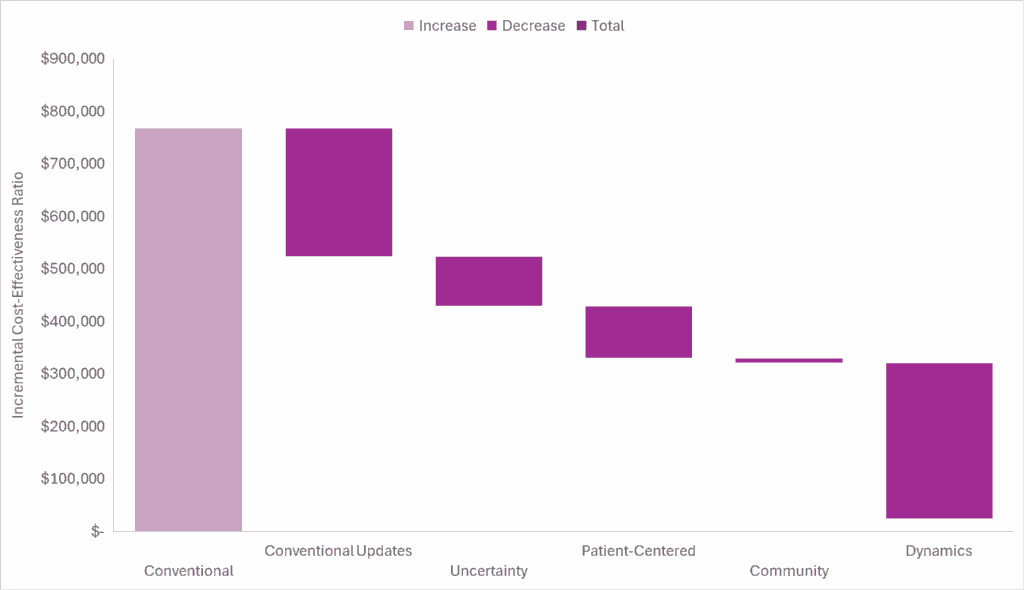
The bottom line is more transparency, consistency, and rigor are required around the Medicare Drug Price Negotiation process if the “negotiations” are going to occur during the patent period. Innovators and investors must have the information necessary to inform their decisions.
SAD BUT TRUE
Although debate around the exact magnitude of the relationship between global drug revenues, R&D spending, and new drugs brought to market exists, it is well accepted that profitability influences subsequent innovation. Another great piece by Dr. Darius Lakdawalla (though, at 53 pages, is not as digestible as the commentary linked above) summarizes some of the empirical evidence around these relationships.
I am not bringing this up to debate the specific magnitude of the relationship. Rather, I bring this up to talk about opportunity costs.
I conduct cost-effectiveness analyses for a living. The outcome from a cost-effectiveness analysis (i.e., the incremental cost-effectiveness ratio) can be compared to a cost-effectiveness threshold that can be calculated using a few different approaches (e.g., opportunity cost, willingness to pay, GDP).
The US doesn’t use a single or explicit threshold in health policy making, but an estimate of the US opportunity cost threshold is around $104,000 per quality-adjusted life year gained. This estimate was calculated by simulating the short-term mortality and morbidity that is assumed to result from people dropping their health insurance coverage due to insurance premium increases. Considering the consequences of drugs that are priced above that threshold with goals of promoting the efficient use of our pooled healthcare resources was central to my training in health economics.
The efficient use of pooled resources is also central to healthcare investors, who are responsible for investing capital from retirement accounts, pension funds, endowments, individuals, foundations, etc. There are opportunity costs in the healthcare investing space too—something that wasn’t central to my training.
The opportunity costs of reductions in the profitability of healthcare innovation (e.g., from measures like price controls over the patent period) must not be ignored. Just as our resources for paying for healthcare have opportunity costs, so do the resources of investors (e.g., opportunities to invest in other areas with higher returns, less risk, etc.).
While we are figuring out ways to improve the efficiency of the US healthcare system, we must engage and trust the perspective of innovators and investors to ensure healthcare innovation is protected and promoted.
WE DID IT AGAIN
On September 12, 2012, Aubagio® (oral teriflunomide) was approved for relapsing forms of multiple sclerosis. Teriflunomide is an oral disease-modifying treatment for multiple sclerosis. The clinical trials showed a “36.3-percent reduction in annualized relapse rate and a 31.5-percent reduction in the risk of 12-week sustained accumulation of disability, compared to placebo.”
The manufacturer announced it would be launched at a price of $45,000 per year. Inflated to present value, that would be nearly $55,000 per year at launch.
Fast forward to today, less than 13 years after approval, and multiple generic versions are available. Check out this article if you want to read why generic competition entered less than 11 years after approval.
Teriflunomide is now about a quarter a day from the Mark Cuban Cost Plus Drug Company. That’s less than $100 a year, which represents more than a 99% discount off the launch price. As designed, once generic competition entered, the price fell off a cliff.
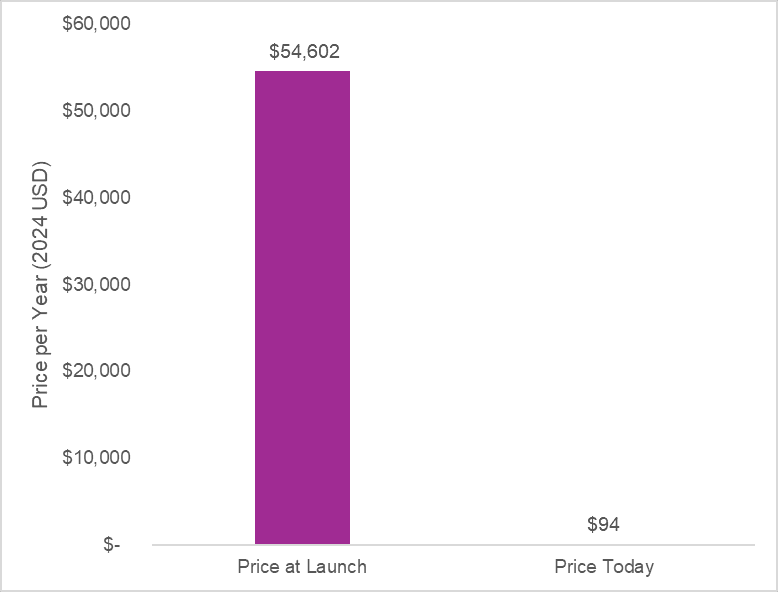
The system worked as designed. Society paid back the innovator over a period of time and then the price substantially dropped. The “high” price we paid during the exclusivity period incentivized the development of this innovation (and others). The low price we pay now is why we did it.
We must find a way to think long-term when judging the prices of drugs. We often celebrate once an innovation gets approved. A celebration is certainly warranted—new treatments are a remarkable and necessary thing—but we aren’t across the finish line yet. We still need to pay back the innovator and investors.
We should also celebrate once the patent period has ended and cheap generic versions are allowed to enter the market, because that is the finish line.
Disclosures
The Center for Pharmacoeconomics (“CPE”) is a division of MEDACorp LLC (“MEDACorp”). CPE is committed to advancing the understanding and evaluating the economic and societal benefits of healthcare treatments in the United States. Through its thought leadership, evaluations, and advisory services, CPE supports decisions intended to improve societal outcomes. MEDACorp, an affiliate of Leerink Partners LLC (“Leerink Partners”), maintains a global network of independent healthcare professionals providing industry and market insights to Leerink Partners and its clients. The information provided by the Center for Pharmacoeconomics is intended for the sole use of the recipient, is for informational purposes only, and does not constitute investment or other advice or a recommendation or offer to buy or sell any security, product, or service. The information has been obtained from sources that we believe reliable, but we do not represent that it is accurate or complete and it should not be relied upon as such. All information is subject to change without notice, and any opinions and information contained herein are as of the date of this material, and MEDACorp does not undertake any obligation to update them. This document may not be reproduced, edited, or circulated without the express written consent of MEDACorp.
© 2026 MEDACorp LLC. All Rights Reserved.
Disclosures
The Center for Pharmacoeconomics (“CPE”) is a division of MEDACorp LLC (“MEDACorp”). CPE is committed to advancing the understanding and evaluating the economic and societal benefits of healthcare treatments in the United States. Through its thought leadership, evaluations, and advisory services, CPE supports decisions intended to improve societal outcomes. MEDACorp, an affiliate of Leerink Partners LLC (“Leerink Partners”), maintains a global network of independent healthcare professionals providing industry and market insights to Leerink Partners and its clients. The information provided by the Center for Pharmacoeconomics is intended for the sole use of the recipient, is for informational purposes only, and does not constitute investment or other advice or a recommendation or offer to buy or sell any security, product, or service. The information has been obtained from sources that we believe reliable, but we do not represent that it is accurate or complete and it should not be relied upon as such. All information is subject to change without notice, and any opinions and information contained herein are as of the date of this material, and MEDACorp does not undertake any obligation to update them. This document may not be reproduced, edited, or circulated without the express written consent of MEDACorp.
© 2026 MEDACorp LLC. All Rights Reserved.
Disclosures
The Center for Pharmacoeconomics (“CPE”) is a division of MEDACorp LLC (“MEDACorp”). CPE is committed to advancing the understanding and evaluating the economic and societal benefits of healthcare treatments in the United States. Through its thought leadership, evaluations, and advisory services, CPE supports decisions intended to improve societal outcomes. MEDACorp, an affiliate of Leerink Partners LLC (“Leerink Partners”), maintains a global network of independent healthcare professionals providing industry and market insights to Leerink Partners and its clients. The information provided by the Center for Pharmacoeconomics is intended for the sole use of the recipient, is for informational purposes only, and does not constitute investment or other advice or a recommendation or offer to buy or sell any security, product, or service. The information has been obtained from sources that we believe reliable, but we do not represent that it is accurate or complete and it should not be relied upon as such. All information is subject to change without notice, and any opinions and information contained herein are as of the date of this material, and MEDACorp does not undertake any obligation to update them. This document may not be reproduced, edited, or circulated without the express written consent of MEDACorp.
© 2026 MEDACorp LLC. All Rights Reserved.