December 2, 2025
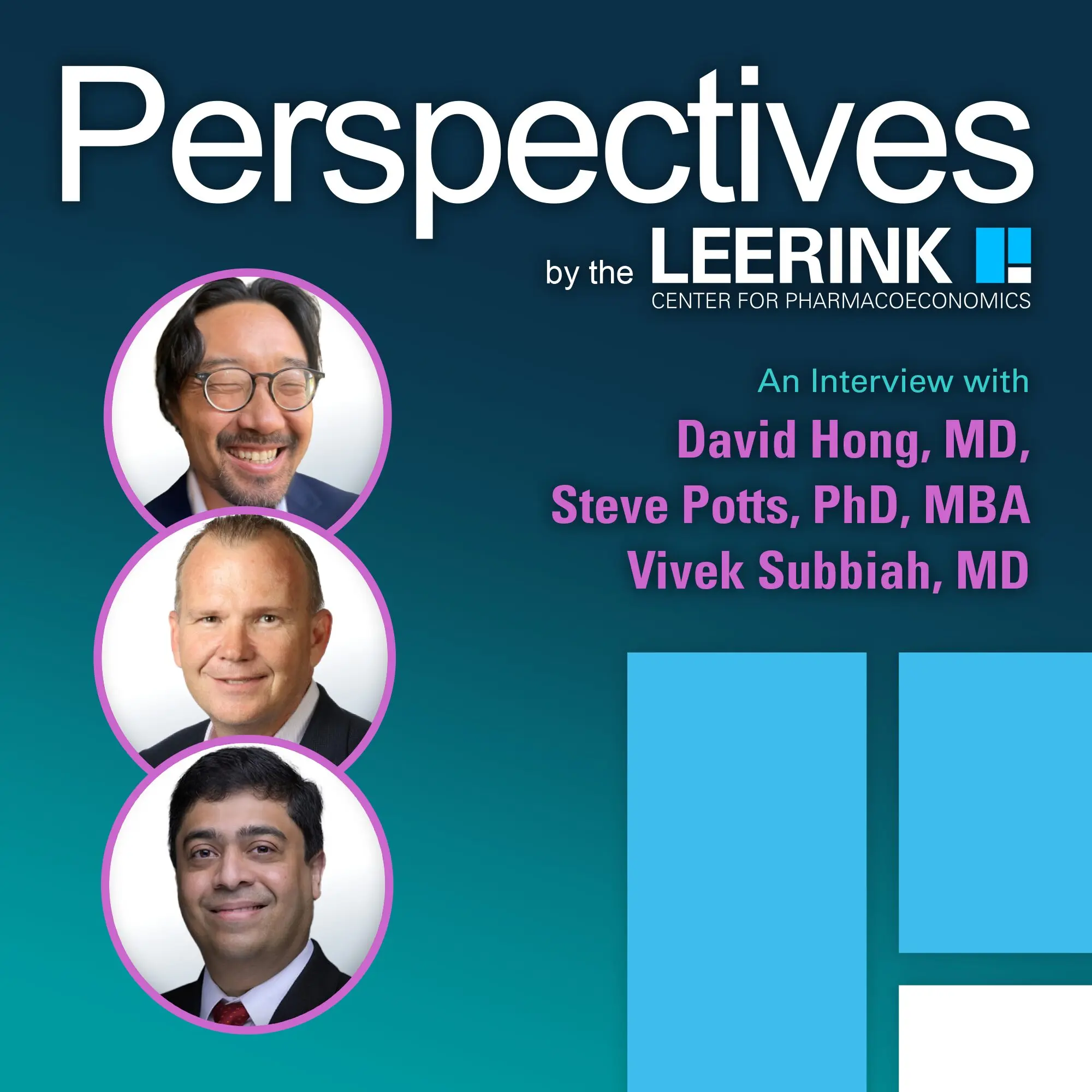
Welcome to Perspectives, a signature podcast series from The Leerink Center for Pharmacoeconomics. Hosted by Dr. Mel Whittington, a health economist and Head of the Center for Pharmacoeconomics, we will be hearing from individuals across the industry to better understand and appreciate the societal impact of healthcare innovations.
Mel Whittington: All right. Hi, everyone. This is going to be a really special episode as I get to talk to and learn from three celebrities in the cancer research space. And it’s definitely one of those moments where I’m like, how did I manage to integrate myself into this conversation? But here we are. I’m sure glad I am. So just to briefly set up the episode. Dr. Steve Potts was on this podcast two episodes ago, and we were talking about the impact of the Inflation Reduction Act on cancer drug development. And he talked to us about how the drug pricing provisions within the Inflation Reduction Act don’t only impact the specific list of drugs that are already in the market and are selected for this kind of negotiation process, but components of the policy also send signals to investors and drug developers and therefore, can impact the drugs are developed and the commercialization strategy. So, Steve expanded on how these different time clocks for this negotiated price to set in nine years for small molecules and 13 years for biologics. These different time clocks, they send different signals for development and commercialization. And since we released that episode with Steve, I’ve had a ton of follow-up conversations with people, including Steve. And so, we wanted to kind of continue that conversation today. And so, I’m so grateful Steve was willing to come back on the podcast. We’re also joined by two other leaders in the cancer drug development space. Dr. Hong, who’s the deputy chair of the department of investigational cancer therapeutics at MD Anderson, and Dr. Subbiah, who is the chief of early phase drug development at the Sarah Cannon Research Institute. So first, thank you to the three of you for being willing to talk about cancer drug development and commercialization in this post inflation reduction act world. And I’ve talked to you all beforehand, but one goal of this podcast is to take all of those conversations that are typically reserved for the conference room and bring those ideas out to the world. So, I’m excited to try to do that with you all today. But before we get into the main topics for today’s episode, I’m hoping each of you can briefly introduce yourself, tell us a little bit about your background, why you pursued a career in cancer research. So maybe let’s start with David Hong.
David Hong, MD: Thanks Mel. I’m Dave Hong. I’m the Deputy Director of the Department of Investigation of Cancer Therapeutics. We’re a dedicated, what’s called Early Drug Development Unit at MD Anderson. It’s probably one of the few dedicated units, academic units, at least in the world. Vivek used to be with us. He used to be a faculty member and moved on to bigger and greater things with Sarah Cannon. But we’re still one of the largest, if not the largest academic unit in the world. We run about 250 early drug development trials in cancer and oncology and enroll many, many patients, close to 1,200 patients last year on trials. And it’s an exciting, incredible time for oncology drug development. There are so many new molecules and drugs and ways that we can help patients. When I started in my career was still, it was kind of a desert and it’s now really exploded. And so, it’s an exciting time to be involved and thank you for inviting me.
Mel Whittington: Thank you. Vivek?
Vivek Subbiah, MD: Hi, thanks for having me. It’s a pleasure, privilege to be with Dr. Potts and Dr. Hong. Vivek Subbiah, medical oncologist, early phase drug developer, and I was at MD Anderson Cancer Center. Again, as Dr. Hong mentioned, one of the largest phase one programs in the world for 15 years. I moved three years ago to Sarah Cannon Research Institute, again, which is a drug development center. And we have nine units in the US. Nashville, three sites in Florida, Denver, Oklahoma, Philadelphia, recently acquired another site in Dallas and one site in London. So again, a pleasure, privilege to be a part of all the new drug developments. Again, I would say this is one of the best of times to be an oncologist because we have access to amazing, amazing, amazing drugs, new drugs with new mechanism of action. As Charles Dickens says, it’s the best of times and the worst of times. And so again, it’s so great to be an early phase new drug developer working with all these first in class, best in class molecules and amazing colleagues working in this. Thank you so much for having me.
Mel Whittington: Thank you. Dr. Potts, Steve.
Steve Potts, PhD, MBA: Well, the audience met me a few weeks ago, but just a quick update. I’m a cancer drug developer and just try to serve up, you know, build teams, raise money and serve up the best possible drugs we can through animal preclinical testing, ultimately to these incredible centers like MD Anderson phase one unit and Sarah Cannon that are so productive and do such a good job of the clinical trials. Our job is just to serve these drugs up early as a cancer drug developer. Quick update for the audience. We have come out of stealth. We’ve raised $47 million to date for our non-stealth company that’s now, I guess we have a name, Breakthrough Medicine. We are looking for a couple additional investors. We’re trying to think, let the American living room understand a little bit what actually goes into the drug development and that you have to have it be investable and you have to have a thesis that’s investable and a stable, you know, investment environment. So, I guess you’re seeing a little bit of a microcosm of just what it takes to get a company formed, get a drug built, and then ultimately, hopefully, get good drugs into these kinds of oncologist’s hands so they can test them in clinical trials.
Mel Whittington: Steve, congrats on coming out of stealth. Love the name and congrats on the fundraising.
Steve Potts, PhD, MBA: Thank you. There’s nothing easy about any of this business and I hope I just hope the listener sees how competitive this industry is to make us better. The competition is really healthy and just want to keep that going and you know we’re always drugs are competing companies are competing you know and ultimately decide what gets approved and what should really have the what drugs should have the know the privilege to be given to patients ultimately.
Mel Whittington: Yeah, speaking about competing, did I hear a rumor that two of you might have competed and
Steve Potts, PhD, MBA: I’ll take that first because I don’t think it’s fair to say competition. I would say I admired Dr. Hong across the aisle. And this is a good example. This goes back a while. And it’s good to kind of bring up drug classes that are now kind of approved because you can talk about them. it’s so competitive. We’re not going to talk about what all of us are doing right now. But going back to 2017, 18, we had one drug, Entrectinib. And I was running medical affairs there. And David Hong was doing an incredible job for a competing drug, Larotrectinib. And so, you so often have two drugs just going head-to-head. And so, I actually got to know more thinking of him as a competitor and then found out that we actually had a, I think David’s best friend in high school was one of my best friends in college. And the guy’s now a federal judge. So got to know him. Sometimes your adversary becomes a really good friend. So that’s how I knew, got to know Dr. Hong.
David Hong, MD: Yeah, I’m sure we probably know a lot of your listeners to this because the drug development world is actually a very, very small world. There are probably a handful of early drug development investigators, there are a lot of academic oncologists who do tumor specific studies, actually just dedicated early drug development like Dr. Subbiah, myself, et cetera. It’s actually very small. And then, you know, there’s not a thousand companies, but we oftentimes run into the same people like Steve and others at different companies throughout the course of our career. So, it’s really interesting.
Vivek Subbiah, MD: And absolutely, I think for the broad audience listeners, again, they may be wondering what does Dr. Hong and Dr. Subbaiah do. Again, we are medical oncologists, so we take care of patients. We are medical oncologists, take care of patients, but we are interested in providing cutting edge drugs, working with small biotechs, big pharma, getting these first in class, best in class new drugs into patients, patients with cancer. Again, we run clinics, we run clinical trials and we see you know, tomorrow’s drugs today in clinic. Again, every drug, every preclinical discovery, every drug that is ever discovered has to go through several phases of studies. And that is phase one study, the earliest phase one study. That’s what Dr. Hong and I do. And we are, you know, invested not just in one tumor type, right? So, we see all kinds of tumors.
Mel Whittington: Interesting. I think it shows how interconnected this drug development innovation ecosystem is, that it requires investors and private capital. It requires a strong maybe government funding, NIH infrastructure. It requires oncologists. It requires clinical testing sites. It requires small biotech companies, large pharmaceutical companies, patients. And so, I’m glad we have a few multiple perspectives available to be on this podcast. I want to transition a little bit to kind of the main topic of this podcast. And that is, you know, this drug development and commercialization strategy, particularly for cancer drugs in this world, in this kind of post inflation reduction act world. And, you know, I’ve already mentioned Dr. Potts was on the episode a few weeks ago. He talked about, you know, how the IRA has changed and is changing cancer drug development and commercialization strategies, particularly for small molecules that target the elderly population. And there were three things that he mentioned during the podcast and in our follow-up conversations that I wanted to click back on. And one was that he mentioned the slow physician adoption curves of new oncology therapeutics. He also mentioned it was more typical for a cancer drug to first get approved at a later line of therapy and then gradually move to an earlier line of therapy, pending more evidence and investment. And then the third thing was that he mentioned it was more typical to go for a single tumor approval rather than like a pan cancer or tumor agnostic approvals. And so, all of these things, know, kind of a slow physician adoption curve, a later line of therapy moving to an earlier line of therapy over time, and this single tumor approval rather than tumor agnostic approvals make time over that kind of market exclusivity period really important. You know, he said all of these factors make it so about, I think he had estimated around half of the sales or the revenue are in like the latter, you know, nine to 14 year of when a drug is in the market. And so, for small molecules that may be eligible for Medicare drug price negotiation, that government price intervention could occur as early as nine years, which could potentially cut that revenue and investment incentive in those pivotal years. And so, we wanna talk about a little bit of that with you. But Steve, before I ask their perspective, anything that I’m not summarizing correctly or anything you want to correct me on or add?
Steve Potts, PhD, MBA: No, you nailed it. I mean, the fix here is to make 1313 so they’re even. I think the water’s kind of boiling around us a little bit like frogs, and you don’t notice the change, but absolutely the last five or six years, since IRA, it has gone from two thirds small molecules, one third biologic to exactly the reverse. You know, that’s one aspect. And I just keep thinking of things that we can do to work in this new world of only having nine years. And I think the pan-tumor one is a really interesting one, but I think what you’re gonna see is it’s hard. We have two of the world’s experts. I’m trying to think of the third honestly for pan-tumor approval. These guys are amazing at this. And you’re gonna see, this is really hard. so the answer is to like, you have to hit the ground running with sales like day one, if you’re gonna really have a serious face to an investor and say, you can get the return you need in a small molecule for a large population in oncology. So, I’m just excited about this, because I’d love to just hash this out and let the audience know, what is a pan-tumor approval? How does it work? And can it really solve this problem of just hitting sales right away so that you do, and it isn’t just sales, it’s clinical adoption. I mean, having enough patients taking the drug so that you have that time, given the IRA nine-year window.
David Hong, MD: I think one area that you just hit on, Mel, is this idea of adoption. I can’t imagine what it’s like being a community oncologist right now, because the landscape of oncology is changing so drastically in so many different ways. It is really like drinking from a fire hose. And most of these oncologists who, you know, to their credit, I think are doing their best to learn as much as they can. But the reality is that they didn’t, many of them did not train in the era of next gen sequencing or molecular therapies, et cetera. Vivek and I, I’m much older than Vivek, but I mean, like literally I joined fellowship when Imatinib was just approved. And in 2000, and we knew that there was going to then be an explosion, particularly in precision oncology. And so that’s part of the reason that Waun Ki Hong and Razelle Kurzrock created our working, created our department. But, you know, you go out into the community, and I think a lot of community oncologists are very savvy and they’re very intelligent and they know what’s going on. But I can’t even keep up. with all of the changes that are going across all of oncology, let alone my area. I mean, it is staggering how quickly. And so, I think both you and Steve are right is that some of this is just pure adoption. I think there’s like educational studies that say it takes about seven years for adult learners to actually fully be embedded and incorporate whatever new idea comes out into the landscape. And you know, I’ll tell you one story which is really interesting. we had Sotorasib approved in non-small cell lung cancer. It had been already approved for close to like six or eight months. And I had an MSL come to me and talk to me, and she was telling me that she had this kind of dinner like MSLs do and they invited pathologists and other medical oncologists and they were talking to the speaker. It was not me. I’m not allowed to do these talks, but they had a speaker talk about RAS and then somebody raised their hand and said, you know, Why are we talking about RAS? There’s no drugs approved for RAS. And this was after some RAS had already been approved for close to eight months. And so it just tells you that this information, one, it’s hard to get out fully. And there’s just so much information right now that it is hard for companies’ approvals to be disseminated rapidly into everybody’s cranium.
Mel Whittington: Yeah, and I think that’s a great illustration of how it does take time and then it shows you how also time matters. That if it is going to take, seven years or X number of years to reach peak sales, that’s not at the day of FDA approval or the day of market entry. And so, any policy that is going to impact time or impact that time period of expected market exclusivity periods of, say, 13, 14 years, we have to think about all of those those implications on these other things that matter with time. Vivek?
Vivek Subbiah, MD: Yeah, no, again, you know, we spoke about the pan-tumor or tumor agnostic, right? So again, people might be wondering what is that?
Mel Whittington: Yes, I am. Thank you.
Vivek Subbiah, MD: So, the traditional approach to cancer treatment has been primarily from where the cancer arises. Like we call it organ centric with therapies developed based on where it originated from, like breast cancer, lung cancer, prostate cancer, brain cancer, et cetera. This paradigm has really dominated oncology for decades, guiding both clinical practice and drug development. But now we have sequenced the genome, right? With the advent of molecular profiling and deepening of the understanding of cancer genomics, this has fundamentally challenged this wisdom. So, we recognize that tumor arising in different organs can share similar molecular pathways. So, this realization has catalyzed a revolutionary shift in oncology. And that is what we call as tumor agnostic therapy wherein we don’t focus on the cancer not breast cancer, kidney cancer, lung cancer, but focusing on the biomarker or the target right so these innovative treatment target specific molecular alliteration regardless from where they arise in the body so the watershed moment for tumor agnostic oncology was in 2017, May 2017 when the USFDA approved pembrolizumab for all microsite satellite instability high cancer so this represented watershed moment. Why? Because for the first time in the history of oncology, a drug was approved based on a biomarker, but not based on a cancer. So again, and then followed by we had drugs like a lot of entrectinib led by Dr. Hong and entrectinib for enteric fusion in a positive cancer. So, this cemented the approach. So right now, in the last decade alone, we have not one, not two, but ten different drugs approved the tumor agnostic space.
Mel Whittington: And the first one was what year was that 2017?
Vivek Subbiah, MD: 2017, first one was 2017 and then subsequently 2018 we had a Larotrectinib, 2019 August we had an entrectinib and then 2020 pembrolizumab again got approved for TMB high cancers, 2021 daclizumab, second checkpoint was approved for same-day MMR cancers and again June 2022, dabrafenib and rrametinib was approved for all BRAF mutant cancers and again I let this BRAF know make combination approval in tumor agnostic and I can explain why we need tumor agnostic approvals because think about the date. The combination of daclizumab and Trimatinib was approved June 2022, right, across all cancers. In melanoma, this drug was approved in 2013. So, a patient with BRA V600E mutant melanoma had access to this drug in 2013. Whereas a patient with say rare cancer like salivary gland cancer or a biliary tract cancer or a glioblastoma did not have access to this drug until 2022. So, in the real world, patients have access to drugs only when the drug is FDA approved. Not many patients can go to niche boutique academic centers or drug development units to seek access to these novel precision medicines. So, this leads to what I call it as molecular inequity. Just because the tumor was in a different organ, that patient did not have access to this therapy. So that’s what we are talking about. This is pan-tumor. Again, my vision and my hope is that in the next 25, 50 years, we should have 100 drugs approved in a tissue agnostic pan-tumor space. The biology or where the tumor came from should not matter.
Mel Whittington: Okay, well I have so many questions about pan-tumor versus tumor specific, but Steve, I want to ask you a quick question related to this of bringing this back to the Inflation Reduction Act and commercialization strategies. Is this one potential strategy going for this kind of pan cancer approval versus tumor specific? Is that a way at say time zero to expand the population size and be able to target a larger population initially and kind of hit that ground running at launch? Is this more complicated? And I’m going to ask you that and then I have a bunch of questions back. I’m like, well, how the heck does this actually get approved? And what is the patient experience, et cetera?
Steve Potts, PhD, MBA: So absolutely it is from an approval standpoint, and then you have it. But then there’s the realities of the adoption. And I had a team of 12 MSLs in 16 countries trying to really build adoption for NTRK, which they never heard of. So, we gave it fancy names like Star Trek and the Star Trek Trial. But the essential challenge here, the joke I use to kind of make fun of my own educational background, it’s if you get an MBA, you go to school and you learn nothing about everything, right? Or you go to school and you get a PhD and you learn everything about nothing. You know, it’s very deep but very narrow, right? And so of course you’re talking to someone that knows nothing about nothing. But the challenge here is the pan-tumor approval is really a very broad but very thin evidence base. And so, when you go into a busy like community oncologist who take a lung, take a maybe a pancreatic cancer as an example, and I just lost a friend from pancreatic cancer that had a G2LD mutation and with community practice and the community oncologist wasn’t even aware there was G2LD drugs, so there’s no targetable mutation here and it was just like, you know, can’t, pancreatic patients every month matters and you can’t rewind back and get them on a drug like the Revolution Medicines glues or something like that. So I’m very aware of this personally too, but you, you. You can’t build that evidence base because it’s thin and across so many different tumor areas. So, that’s why this is an incredible idea from an approval standpoint, but the reality of how do you get the adoption when you have a few patients in pancreatic, a few patients in lung, a few patients colorectal, and you’re trying to build really an evidence case of why this drug is good, does it improve survival, et cetera. So, it’s just a really challenging area, and that’s why I use my MBA versus PhD analogy, maybe dumb as it is.
Vivek Subbiah, MD: Interestingly, for a broad context, recently there was a paper published by Caris group, real-world data on NTRK and all tissue agnostic drugs. first people complained that we cannot find these NTRK fusions. So, they found around 230 patients with NTRK fusions. But in the real world, less than one-third of the patients really got the drug. So, again, they are picking these needles in haystacks, but they are not threading the needle. So, we have a problem. Again, that’s a huge gap.
Steve Potts, PhD, MBA: David should chime in here. I’ve seen what you did to drive adoption of TRK. It was amazing. So, I’d love to hear your thoughts.
David Hong, MD: It was a drug I think, Larotrectinib and Entractin, both drugs are, I don’t know how many more years they have left on their drug exclusivity, but it was really, I always tell doctors and patients, these are like almost like lottery tickets because if you have an NTRK fusion and you can get Larotrectinib or Entractin, and now repotrectinib which is kind of the second generation, They, like I had patients still from the phase one trial almost a decade later and they had metastatic cancer, which by definition most metastatic cancers are not curable. And these patients are still alive, doing well, almost a decade later. And you ask yourself, if we could find this alteration and then we can get these drugs that can also specifically target these kind of fusions, really can change the, in fact, we did analysis of all these patients who were really profound responders of Larotrectinib this past ESMO. And it’s amazing, you know, they’re close to five years survival is the median survival in these patients who have metastatic disease that most of them probably don’t have likely survival beyond six months. And so, I think part of the reason that we’re on this conference is that, you know, one is to get awareness that these tumor agnostic therapies can be very, very powerful and beneficial to our patients, but also, you one of the things I’ve seen now with the NTRK space is that there is no more drug development at this point. It doesn’t really make sense with IRA if you only got nine years of drugs exclusivity really to develop the next generation, I think, of small molecules in a relatively small population. But this is where I still think that if they did have a little bit long drug exclusivity bandwidth with small molecules, you probably would have more investors into the space in the future.
Mel Whittington: And David, do you think that’s largely because that nine-year time clock, there’s just a lot that that changes on the development and commercialization side?
David Hong, MD: My guess is that yes, there’s, again, there’s only a small, the actual number of patients here is relatively small, unless you can make back on your investment in something like this. It doesn’t make sense to really go into a third generation that could overcome even better efficacy than repotrectinib, which is the second generation. And so, my guess is that we’ve really not seen any really push by either small biotech or even Chinese biotech. I think there was, I heard there was maybe one Chinese biotech who’s thinking of this space, but they haven’t approached us. So, I think to a large extent it has to do with this and I totally agree with Steve. We run a lot of studies. There’s definitely a shift towards more kind of IV related medications, ADCs, immunotherapy, chemotherapy that can be given through the IV versus small molecules. Not to say that small molecule development still doesn’t exist. We have a lot of RAS inhibitors that are still in play. But I do think that there is a shift towards that. I think that overall, the IRA is affecting though is kind of the rare tumor population because rare tumor population, particularly these molecular alterations, there’s this long tail where there’s only a very small population of patients, whether it’s common tumors or rare population already in rare tumors, that usually these target therapies are oral, are just not going to get developed because, you know, it’s just the actual drug exclusivity is too short.
Mel Whittington: Interesting. So, I want to go back to these kind of pan-cancer approvals because this is very new for me. But how does the evidence required for regulatory approval differ? And the reason I ask is, so I’m a pharmacoeconomist. I think about building economic models for drugs that are maybe recently approved. And my models are disease specific. If I’m going to model a breast cancer drug, I’m going to look for overall survival and progression free survival curves for this breast cancer population. My other model inputs are going to be health state costs and quality of life inputs specific to that breast cancer population. So, thinking about kind of building a, like evaluating a pan cancer drug. What evidence requirements would there be for regulatory? Would that set it up well for evidence that’s often needed for market access or HGA internationally, et cetera? So, kind of what evidence is used for these pan-cancer drugs?
Vivek Subbiah, MD: Again, over the last decade, each and every one of these, you know, nine or 10 drugs that have been approved has been, we learned a lot from these drug approvals, right? Right from Pembrolizumab, that was not the first approval, right? Pembrolizumab had 10 other indications, and this was a supplemental indication. And NTRK, Larotrectinib was the first ever, right, primary tissue agnostic approval because there was not one particular cancer where NTRK was seen, right? Every cancer had 1% of NTRK fusion. So, it was a real tissue agnostic approval. Again, same thing with Entrectinib right? That fast followed on the Larotrectinib. Again, the evidence and then the rest of them, right? You see Pembrolizumab, Dostarlimab, Selpercatinib, repotrectinib, Dabrafenib Trametinib, and then recently nHER2, Entrectinib, (inaudible). Again, all these tissue agnostic approvals have a common theme, right? So the evidence is from single-arm studies in different tumor types. And the primary evidence, right, has been in most of the cases in specific tumor-specific cohorts with using randomized studies. So MSI high cancers, right, microsite satellite instability high cancers, colorectal cancer, five to six percent to 15%, depending upon where the patient presents, the drug has a randomized evidence in MSI high in all other cancers. Like we have 30 different tumor types in whom the drug pembrolizumab works. So, it’s impossible. It’s infeasible to do a randomized study in every tumor type in every line of therapy.
Mel Whittington: So, these are single arm?
Vivek Subbiah, MD: Yeah, single arm study, single arm studies, because these are biomarker driven studies, biomarker driven studies. And usually all these have a very high response rate. Each and every one of these drugs that got approved has a high, high, high response rate.
David Hong, MD: I don’t know if you know Steve Lemery at the FDA, or Rick Pazdur. They’re really the architects of this new tumor agnostic therapy indication. And I think it would be great if you could ever get them on the podcast. They did write a white paper in 2022, I think, kind of give indication. Obviously, they’re never 100% clear exactly what leads to FDA approval. But they kind of lay it out. if you look at most of these approvals, they can bring in other studies, like for example, Vivek said that there’s been a number of studies done with PEMBRO, et cetera. And then they allow for these rare tumor types. There’s no way you can do a randomized trial line because it’s just too rare. And to see not only high response rates, because response rates in the end, as you know as a pharmacoeconomist and probably a statistician, is that it’s a surrogate, right? It’s a surrogate to PFS, it’s a surrogate to all survival. But high response rates with relatively long duration of response. If you look at most of these indications, they not only have high response rates across most of the tumors, not all of them. They also have longer duration of response than you would typically see in that kind of refractory population. So, it has, that has led to a number of these, and there are critics who argue that this is not necessarily, could these patients not, really benefit in overall survival because you’re just basing it upon response rate and surrogates. But I would probably argue that at least from the Larotrectinib data set that we got, for example, recently, that most of these response rates will translate into really durable survival. And so that’s the impetus for the approval.
Vivek Subbiah, MD: So, we looked into the criteria, right? What is the minimum criteria? So again, all these nine approvals, we charted it out. And what it showed that they need to have an objective response data for at least 20 to 30% and above in at least four to five different tumor types. And each tumor type should have at least four to five available patients in the relapse refractory setting. Again, those are the minimum, bare minimum criteria for a target or a drug to be tumor agnostic.
Steve Potts, PhD, MBA: Yeah. And Mel, like from an economist standpoint, I mean, the data has to be jaw dropping for response rates. just like Vivek said, jaw dropping response rates on multiple tumor types. But you, course, when you want to economic model, are thinking, all right, so this drug in breast cancer compared to this other drug that has 10,000 women that have taken it and has this huge amount of information about it, how does it compare? And you just simply don’t have that data set. And this is why, like in Europe, in Europe, you basically can’t get, no matter how great precision medicine is and how much helpful it is. It’s priced like chemo until you have that kind of survival data and you’re never gonna get it in this kind of population, which is why Europe mostly is, most cancer patients in this area are basically getting drugs from clinical trials, not from actual prescriptions.
Vivek Subbiah, MD: You know, personally, believe again, economic models are great. I think it should be patient driven drug development, patient centric drug development. And it’ll all add up. It’ll all add up because the reason why is that if you think about all rare cancers put together, they come to 20 to 25%. Think about that. The paradigm in drug development is such that and drug developers, we usually focus on the horses, not the zebras, but on breast cancer, lung cancer, colon cancer, not the zebras. But, again, betting our odds on zebras, it’s an easier win than betting our bets on the horses where there is fierce so much competition. And again, 20 to 25%. Again, think about the economic model, right? It’s a huge, huge, huge chunk of patients that are not just one disease, but there are hundreds and thousands of diseases among those patients, right? So, they are left out in the drug development. And then this pan-tumor, tumor agnostic drug development, can address those zebras.
Steve Potts, PhD, MBA: I don’t want to minimize what these two institutions have done in the pan tumor area. We used to have a joke, imagine 12 MSLs in 16 countries trying to find all these patients. We tested 30,000 patients to find 50 TRK patients. All those, like David Hong says, have a lottery ticket, but in all these tumor types, they’d never heard of it. And we used to joke that the oncopolitics, and these guys have done an amazing job of breaking down oncopolitics at their institutions. And what I mean is like the lung cancer group just, they do lung cancer and you’re not used to having someone from colorectal show up and say, “hey, we’ve got this drug that looks really good in colorectal. It happens to have the same mutation as some of your lung cancer patients.” like, you know, there’s silos and they’ve done a great job of breaking down the oncopolitics at their institutions.
Mel Whittington: Yeah, that’s, that’s is really exciting about how it takes us honestly back to the adoption piece of this field evolves constantly. There’s innovation, there’s excitement. Like we are all working toward making the patient experience better and making patient lives better and making society better. And so how can we all work together better and collaborate together better and figure out like, okay, this is a great strategy. How do we align expectations and kind of raise adoption and get people from all different sectors of the biopharmaceutical innovation ecosystem kind of aligned where this could be feasible.
Steve Potts, PhD, MBA: We’ve just made so much progress. I hate, I just hate to see, there’s so many more areas that we can go after with some of these small molecules and biologics too, but you just don’t want to see the momentum get, you know, have cold water put on it by the nine years. So, all of this still goes back to moving the nine years out to 13, you know, but I think the pan tumor thing is something we absolutely need to be much more aggressively pursuing. I think it is really going to help.
David Hong, MD: I agree, Steve. I think there will be a lot of new drugs. RAS is a target that for decades we weren’t able to target. And now we have drugs that look like they’re working incredibly in the RAS space. There’s other targets such as MTAP loss. There’s other targets such as MET. These are all classes of drugs that will probably move forward and have the possibility if not the opportunity to really kind of target that long tail especially for rare tumor patients and like Vivek said like that’s if you combine all that that’s like 25% of all oncology so.
Vivek Subbiah, MD: No, absolutely. I think, you know, we live in an amazing, amazing unprecedented, you know, transformative era in oncology. Again, to see these drugs work, right? You know, some of the drugs like Entrectinib or Selpercatinib or Larotrectinib. You know, I’ve seen patients go from hospice to, you know, full time jobs, getting married. Again, it’s amazing. Again, as early phase drug developers, you know, that’s why we do what we do. And again, I think we shouldn’t lose the momentum here. know, tumors don’t follow rules. They defy classification. They are malignant snowflakes. And I personally think that therapy should be age agnostic, tissue agnostic, line agnostic. And we need to have a biomarker-driven, patient-centric drug development model. And I think it was an inadvertent consequence of the IRA, the nine versus 13. I don’t think so anyone realized that. But more and more patients, again, I go back to the rare cancer and pediatric cancer patients because I think those patients are going to be most affected with this kind of a situation here.
Mel Whittington: I do want to ask one final question and that is, know, if you could fast forward 10 years, what breakthrough would you hope to see in oncology and what do need to do to make that happen? Maybe Steve, let’s start with you.
Steve Potts, PhD, MBA: Well, we’re working on a few things, but they’re early.
Mel Whittington: You’ll notice the word I used, I used breakthrough.
Steve Potts, PhD, MBA: But they’re early, they’re early and they’re hard, you know, and you’ve got to work on a number of things. I think, I really think that the breaking down of the oncopolitics at across tumor types at these cancer institutions is going to be amazing. And we’re going to get more of that as we have these pan tumor approvals, because they’re just, you’re going to be naturally thinking more broadly across tumors instead of only in your particular tumor type and your particular area. So, I think letting that play out, know, these, adoption is slow, these things take a while, but just letting that whole idea really play out, just in these top centers, but really in middle America, in Latin America, across globally, and just seeing that play out is going to be fascinating.
Mel Whittington: Vivek?
Vivek Subbiah, MD: To confront cancer, the emperor of all maladies, it is essential for us to rigorously evaluate every promising data, and idea, and approach. And I think AI is going to transform how we classify cancer. There’s huge revolutionary potential here. And this demands unprecedented stakeholder integration. And all these obstacles, the diagnostic inequities, resistance mechanisms, IRA, regulatory complexities, economic challenges, are all human constructs. They are all formidable. They can be dismantled through systemic collaboration. again, in the next 10 years or 20 years or 30 years, my hope is that we will have 100 different drugs approved in tumor agnostic space. So, this is a call to academic arms, I would say. So, when implemented, we will have therapies for patients, for every patient, regardless of where the tumors originated from, regardless of tumor type, and we will have a shot at the right therapy, at the right time, and for the right reason.
Mel Whittington: Love that. David?
David Hong, MD: My hope is that, you know, like 10 years from now, across all stages, not just metastatic, but every cancer patient gets not only a whole genomic profile, but they get a whole proteomic profile, maybe an epigenetic profile. And whether it’s through AI, whether it’s just through, you know, doctors understanding what to give, be able to say, “hey, okay, you have, you know, stage one, I don’t know, prostate cancer or stage one pancreatic cancer, we’re going to give you a Whipple or stage two pancreatic and we’re going to get a Whipple it. And then we can give, we know that this tumor harbors a RAS plus this. We’re going to give you these drugs kind of in the adjuvant setting. And, you know, the chances are that you’re going to survive this deadly disease that, uh, 10 years ago was, you probably had a less than 5% chance of living beyond five years, you know?” So, I hope that we can get there, you know, and I think all these different technologies will. But we also need the drugs to be able to target, precisely target these tumors. And so, I would argue that, you know, what Steve, know Steve’s a real proponent to try to change around the IRA policy that we can do that in order to really get, have an armamentarium of these drugs. But I think that this will come about at some point. How much of that will be because of policies and changing alcohol politics. I don’t know, but I think we will start, we’re already starting to do a whole genome sequencing in almost every patient, starting to develop whole proteomic profiles, et cetera, et cetera. So, it will come, it’s just a matter of these policies and some of this politics. The technology’s here.
Mel Whittington: I love that. Well, again, I want to thank you three so much for coming on the podcast. I’m going to have to listen to this one multiple times because I’ve already learned so much. I’m excited to kind of learn a new element every single time I listen to it. I think talking to people who are so pivotal to a drug in its very earliest phases, in that phase one period, it kind of gives other stakeholders in this biopharmaceutical innovation ecosystem to kind of see, okay, what’s coming? How can we make sure that we are ready for innovation so we can get the right drug to the right patient? And how can we facilitate that in a really promising way? So, thank you again for all of your work.
Thank you for listening to this episode of Perspectives. If you’re interested in participating in future podcasts or would like to learn more about the Leerink Center for Pharmacoeconomics, please email cpe@medacorp.com.
The Center for Pharmacoeconomics (“CPE”) is a division of MEDACorp LLC (“MEDACorp”). CPE is committed to advancing the understanding and evaluating the economic and societal benefits of healthcare treatments in the United States. Through its thought leadership, evaluations, and advisory services, CPE supports decisions intended to improve societal outcomes. MEDACorp, an affiliate of Leerink Partners LLC (“Leerink Partners”), maintains a global network of independent healthcare professionals providing industry and market insights to Leerink Partners and its clients. The information provided by the Center for Pharmacoeconomics is intended for the sole use of the recipient, is for informational purposes only, and does not constitute investment or other advice or a recommendation or offer to buy or sell any security, product, or service. The information has been obtained from sources that we believe reliable, but we do not represent that it is accurate or complete and it should not be relied upon as such. All information is subject to change without notice, and any opinions and information contained herein are as of the date of this material, and MEDACorp does not undertake any obligation to update them. This document may not be reproduced, edited, or circulated without the express written consent of MEDACorp.
© 2026 MEDACorp LLC. All Rights Reserved.